

The Blog

Postpartum Exercise: Where to Start and Why
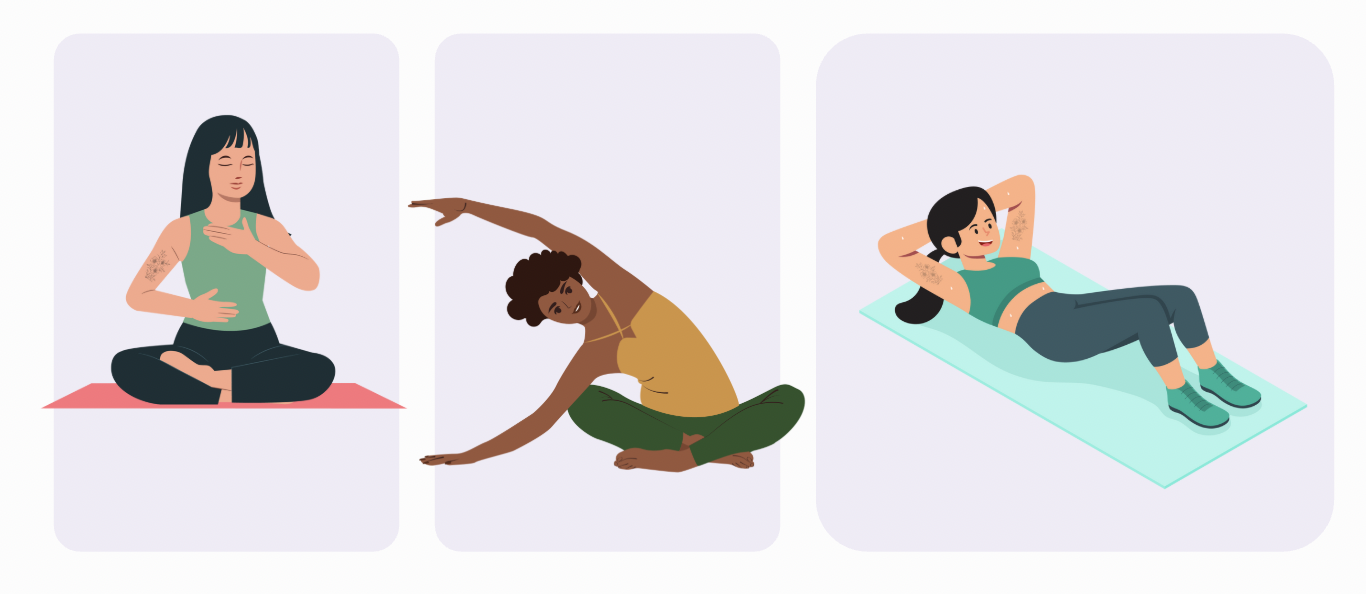
If you’re navigating postpartum fitness, you’re likely asking: When can I exercise again?
But the more important question is: How do I return to exercise in a way that supports long-term healing?
Pregnancy and birth are major physical events. Just like prenatal fitness prepares the body for pregnancy and birth, postpartum recovery requires intention, education, and patience. Your body doesn’t simply “bounce back” — it heals, reorganizes, and relearns how to move.
Understanding where to start can make all the difference in how you feel not just weeks postpartum, but years from now.
Postpartum Recovery Starts With Acknowledging Change
Your body has been through extraordinary change. Pregnancy affects every system — muscular, hormonal, respiratory, and nervous — and birth places additional demands on the core and pelvic floor.
Just as your baby needs care and nurturing, you do too. Unfortunately, postpartum recovery is often rushed, minimized, or treated as something that should happen automatically.
There is no universal postpartum timeline. Healing looks different for everyone, and comparison only creates unnecessary pressure. While time helps, time alone does not restore strength, coordination, or function — especially when it comes to postpartum fitness.
Common Postpartum Fitness Mistakes to Avoid
1. Jumping Back Into Exercise Too Quickly
Many women assume that being “cleared for exercise” at their 6 week checkup means they can return to any workout they did pre-pregnancy.
Medical clearance simply means tissue healing has occurred — not that your body is ready for impact, heavy lifting, or high-intensity exercise.
In postpartum fitness, foundation always comes first:
- Core and pelvic floor function
- Stability and control
- Then strength, intensity, and impact
Skipping these steps increases the risk of injury and persistent symptoms.
Listen to Your Body’s Signals
Your body communicates clearly when it needs support. Pay attention to:
- Pelvic heaviness or pressure
- Ongoing bleeding
- Bulging, coning, or doming of the abdomen
- Pelvic, hip, or low back pain
- Feeling disconnected from your core
These are signs your pelvic floor and deep core need focused attention — often with guidance from a pelvic floor physical therapist.
2. Doing Nothing Until the 6 Week Checkup
While many providers advise waiting until the 6 week postpartum checkup to resume exercise, that doesn’t mean you should avoid all movement before then.
Early postpartum recovery is an ideal time for:
- Gentle breathwork
- Mobility and circulation
- Nervous system regulation
- Reconnecting with the core and pelvic floor
A full workout at six weeks postpartum should not be your first movement after birth.
3. Not Understanding How Pregnancy and Birth Changed Your Body
Every postpartum body is different.
Factors such as vaginal birth vs. C-section, tearing, stitches, prolapse, or diastasis recti all influence postpartum recovery and exercise readiness.
Common physical changes include:
- A stretched and weakened deep core (transverse abdominis)
- Pelvic floor weakness or excessive tension
- Abdominal separation
- Rib cage and posture changes
- Lower back tightness or pelvic tilt shifts
Learning how to engage your pelvic floor, breathe with a 360° breath, and activate the deep core is foundational for safe postpartum fitness — no matter how far postpartum you are.
A Smarter Approach to Postpartum Fitness: Reconnect, Regain, Rebuild
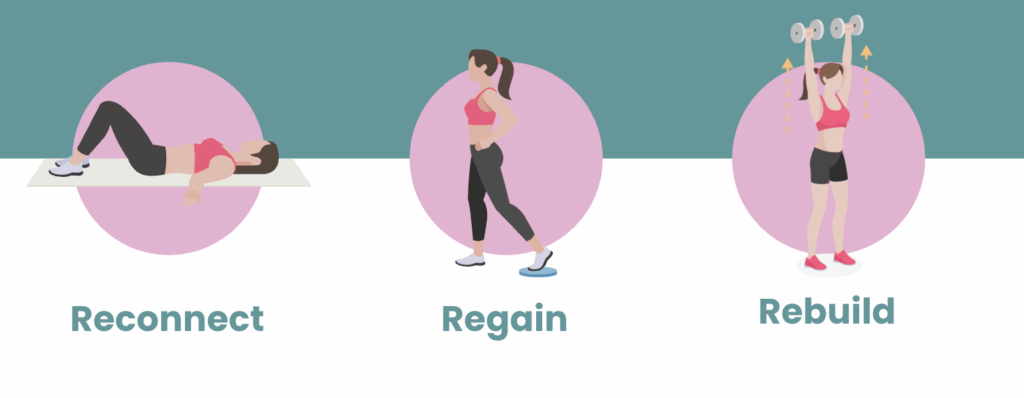
Reconnect
This phase focuses on awareness and control.
- Assess how your body feels post-birth
- Understand your specific recovery needs
- Learn proper core and pelvic floor engagement
- Practice managing pressure during movement
This step reduces injury risk and sets the stage for strength.
Regain
Next, we retrain everyday movements:
- Standing up and sitting down
- Bending and lifting
- Carrying your baby
Functional strength is essential in postpartum recovery. Strengthening stabilizers — glutes, hamstrings, inner thighs, and upper back — supports the pelvic floor and core as demands increase.
Rebuild
Once a solid foundation is established, you can rebuild strength and return to your baseline.
At this stage, your core and pelvic floor are prepared to support more challenging movements, allowing you to safely progress toward your fitness goals.
The Best Postpartum Exercise Support Options
Group fitness classes aren’t always ideal early postpartum. They aren’t individualized, and modifying exercises without guidance can be challenging.
Pelvic floor physical therapy is one of the most valuable resources for postpartum recovery — even if you don’t have symptoms. A pelvic floor PT can assess healing, strength, coordination, and help guide your return to exercise. In many countries, this is standard postpartum care.
Private training with a prenatal and postpartum fitness specialist is another excellent option, though it’s important to work with someone properly educated in postpartum recovery.
Online postpartum fitness programs — like the Her Move Postpartum Program — offer a structured, cost-effective way to rebuild strength. My 10-week program is designed to help women reconnect, regain, and rebuild safely so they can return to the activities they love, and you can try it out with a free trial, for two weeks of free postpartum workouts.
Why Postpartum Recovery Is Worth the Investment
Postpartum recovery is a short season of life — even when it feels long.
How you approach postpartum fitness now affects how your body feels for years to come. Cutting corners can lead to chronic pain, dysfunction, or limitations later. Taking the time to heal properly builds resilience, confidence, and strength that lasts.
You have your whole life to pursue fitness goals.
You have a small window to heal — and heal well.
Your body is worth that investment.
If you’re looking for a safe, progressive program created by a postpartum recovery expert, try out the Her Move Postpartum Recovery Program. Learn more. Start free trial.


Comments will load here
Be the first to comment